ACE PDO Thread Lift Korea: What the Thread Does Under the Skin and Who It Suits
 Dr. Jong Seon Kim · Director, Gangnam HERA8 min readLast updated
On this page
Are you wondering whether an ACE PDO thread lift Korea booking will lift your cheeks and jawline, and what your face will look like on the flight home?
It's worth reading on before you book or decide anything.
After reading, you'll know what a PDO thread does, who it suits and who should skip it, what drives the cost, and how recovery goes from the same day to two weeks, so you can decide whether threads fit your trip.
Hello, I'm Dr. Jong Seon Kim, Director, Gangnam HERA Plastic Surgery Clinic.
At HERA, Custom Thread Lifting takes 20–30 minutes with topical numbing cream and local anesthesia, and the thread directions are set for each face. My colleague Dr. Jong Hoon Lee co-authored LIFTINGOLOGY, a book on lifting in aesthetic medicine.
I write this because many people assume "ACE" is a special thread that decides the result, when the material, the number of threads and their direction matter far more.
In short, an ACE PDO thread lift is an absorbable PDO thread procedure that suits early sagging along the cheeks and jawline, and the lift generally holds 12–24 months depending on your skin.
Book a consultation
Send us your question or a photo on WhatsApp and we will reply in English.
What does a PDO thread actually do under the skin?
PDO is polydioxanone, an absorbable material long used for surgical sutures. Threads with small cogs grip the tissue and hold it a few millimeters higher; smooth threads mainly prompt collagen to form around them.
Think of a hook catching fabric rather than a cut that removes it. Nothing is excised, so a thread lift can reposition tissue that has started to drop, but it can't take away excess skin. The body breaks PDO down over several months, and what holds the lift after that is the collagen laid down along the thread path.
My Custom Thread Lifting uses absorbable threads (PDO, PCL or PLLA), with the thread directions planned for each face, and it is paired with Ultherapy and Titanium RF so energy-based tightening works alongside the mechanical lift. Premium Thread Lifting uses PLA threads with 360° cones and takes 30–60 minutes under local anesthesia. For both, the lift generally holds 12–24 months, with thread count and skin condition moving it either way.
Who is a PDO thread lift right for, and who should skip it?
Threads suit a face where tissue has started to drop but the skin still has some thickness and spring: a jowl that is just beginning, a cheek sitting a little lower than it did, a jawline that has lost its edge. They don't suit heavy, loose skin, and they don't remove fat.
The first thing I want to know is the cause. Softness along the jaw can come from sagging tissue, from a pocket of fat, or from the way the jaw is built, and each one points somewhere different.
| What the face shows | What usually fits | Why |
|---|---|---|
| Early sag along the jaw and cheeks | Custom Thread Lifting | Threads reposition tissue and support collagen |
| Local fat under the chin or along the jaw | Sok-Sok Face Injection | Injection-only; slimming appears over 2–4 weeks |
| Laxity without much drop | Premium Lift Combo | Ultherapy, Thermage and Titanium work on firmness |
| Heavy, loose skin | A surgical facelift consultation | Threads can't remove excess skin |
Two of those rows matter for a short trip. Sok-Sok Face Injection is often planned as 2–3 sessions a few weeks apart, which one visit can't complete. A facelift is a larger operation, and the American Society of Plastic Surgeons lists surgical risks such as bleeding, infection and scarring, along with a longer recovery.
I'd also slow down if your skin is very thin, where a thread can be easier to see or feel, if you take blood thinners, if you have an active skin infection on the face, or if you're pregnant. Threads are used beyond the jaw too: there's a separate post on PDO threads for a loose neck and one on PDO threads around the eyes. For the jaw itself, how jawline PDO threads change over the months picks up where the first weeks end.
Say you're 41, you're in Seoul for five days, and you've noticed the line from your cheek to your jaw softening in photos. Your skin is still fairly firm, and you mostly dislike the early heaviness near the jawline. I would look at how much loose tissue there is, and in a case like this, absorbable PDO threads can be a reasonable fit because the sagging is mild.
If instead you had a lot of loose skin under the chin, I would talk with you about whether threads alone make sense or whether another lifting option fits better. You'd also tell me when you fly home, because that decides how we plan the first days of swelling or small bruises near the insertion points.
What happens on treatment day at HERA?
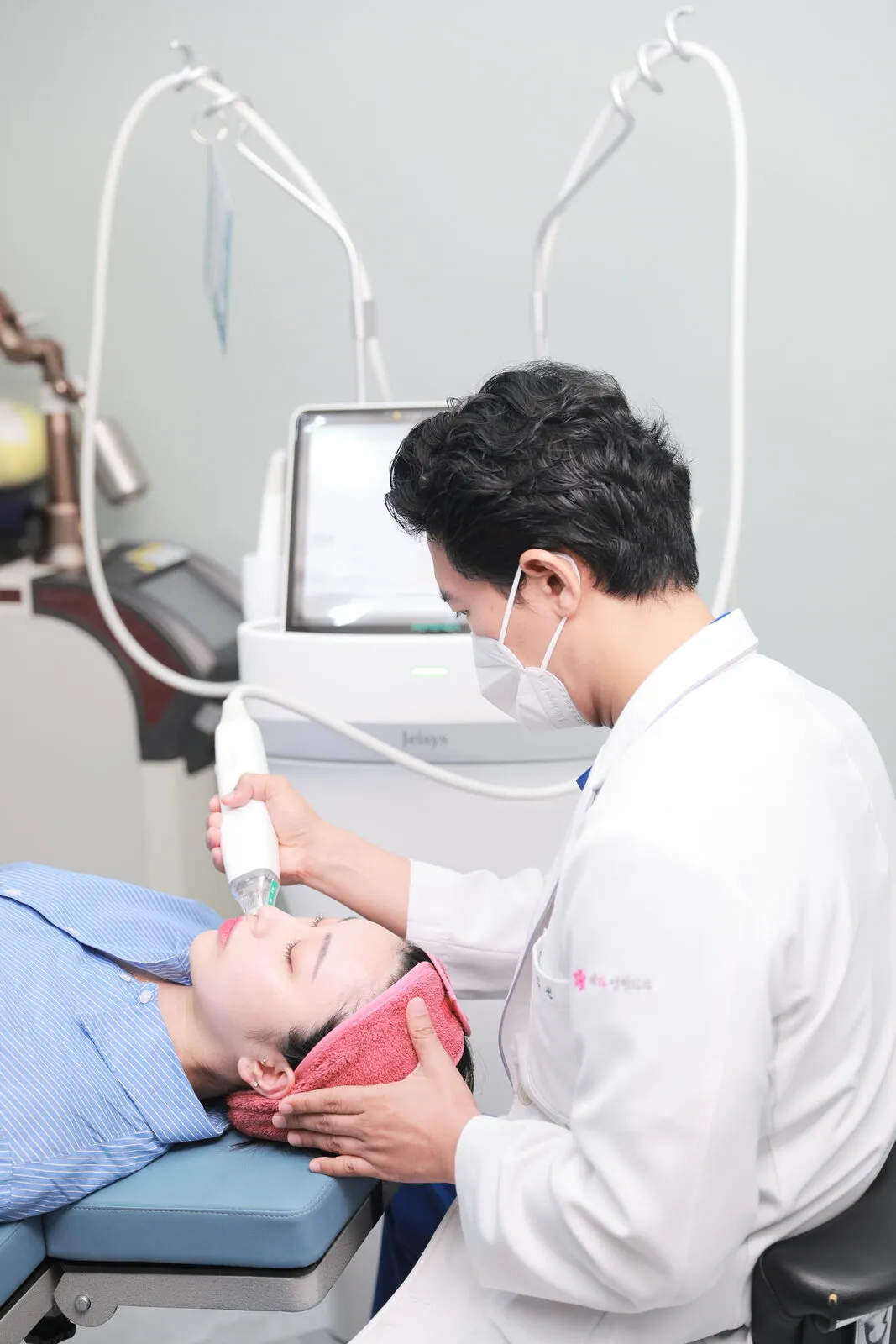
Every treatment here starts with a 1:1 consultation with the specialist who will treat you, and the consultation can be held with an English interpreter. That's where I look at whether the cause is sagging or fat, and where thread direction is planned for your face.
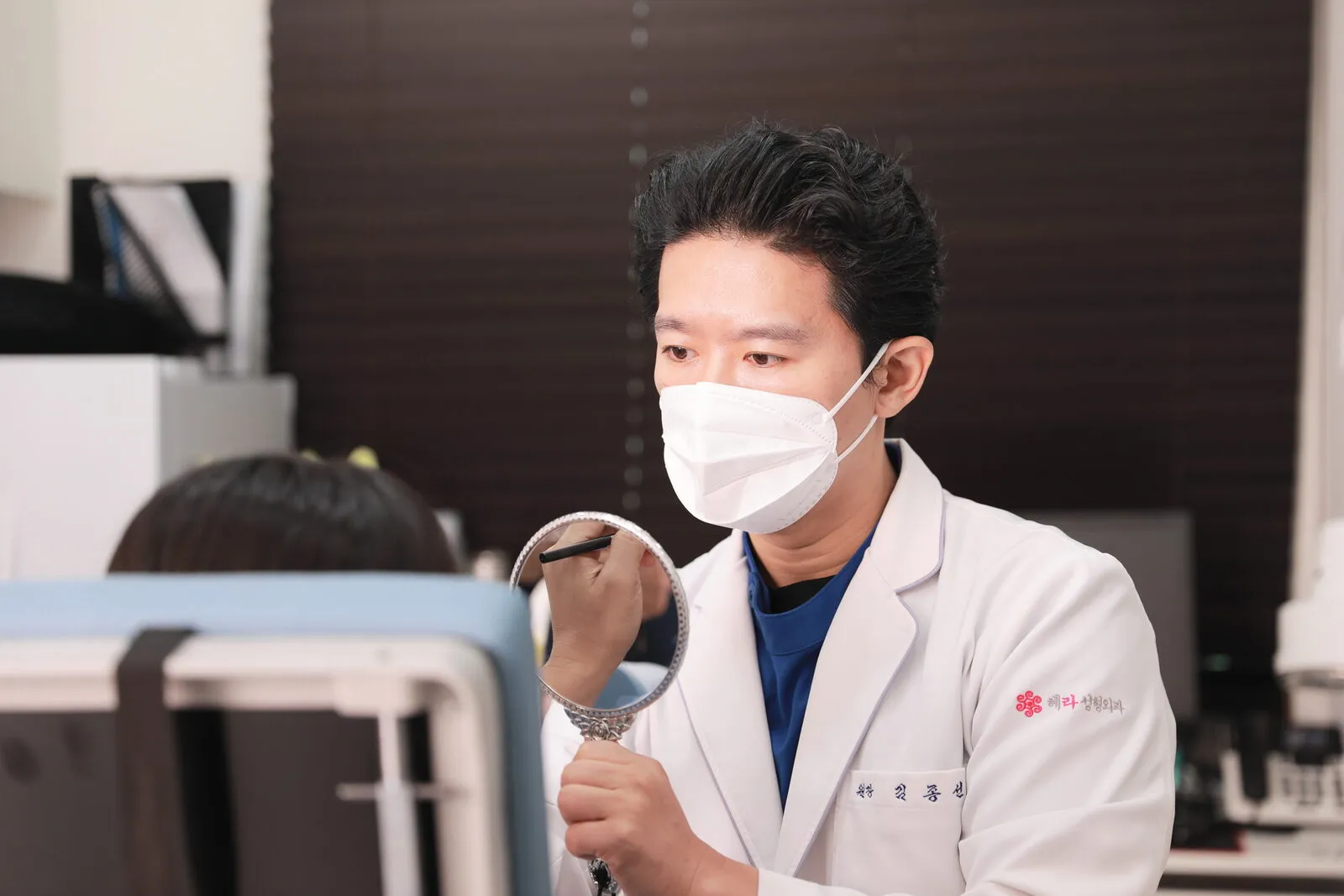
Numbing cream goes on the skin, then local anesthesia at the insertion points. Many people describe pressure and tugging while the threads go in, and a tight feeling once the anesthesia wears off. I use only genuine, approved products, and you can see the treatment pages for each lifting option on the Gangnam HERA homepage.
The calendar matters more than people expect. Saturday hours end at 5 pm and we're closed on Sundays and public holidays, so a weekday treatment leaves more working days before your flight if you want to come back in with a question.
Why the person placing the threads matters
The same thread placed at a different depth or angle gives a different result, and many of the problems people post about online, such as a dimple or a thread end they can feel, come down to placement. That's why I'd weigh who places the threads ahead of the name on the thread.
At HERA we don't rush through high volumes. My colleague Dr. Jong Hoon Lee co-authored LIFTINGOLOGY: Science and Clinical Practice in Aesthetic Medicine, was a clinical instructor at the 2023 KAFC Cadaver Workshop, and has conducted more than 20 thread-lifting seminars and live demonstrations for physicians. At the Korean Society of Aesthetic Surgery in 2018, his conclusion was that both a quality thread and a skilled practitioner are needed.
Dr. Jin Yi Han was congress faculty and session chair at the 8th KAFC Congress in 2026, speaking on threads and fillers for telling midface descent apart from lower-face laxity.
What can go wrong after a thread lift?
Risks and side effects to know
The American Society of Plastic Surgeons lists these thread-lift risks: swelling and bruising, infection, extrusion of a thread, difficulty opening your mouth (usually temporary), pain that could persist, sensitivity to sun or bright light, anesthesia risks, and an unfavorable result.
Its authors noted that swelling usually resolves on its own within about two weeks, and that some dimpling comes with the technique and often settles.
If something changes once you're home, watch for redness that spreads, warmth, rising pain, fever or discharge near an insertion point. Those are reasons to see a doctor locally the same day and to take photos. The US CDC's medical-tourism guidance suggests bringing copies of your records home and planning follow-up care before you travel. How your face responds is individual, and the final plan is made at the in-person consultation.
For a sense of what a full-face thread lift changes over time, see how a thread face lift settles.
Recovery: the same day, day 3, day 7 and two weeks
On the day, numbness fades over a few hours and the face feels tight, most of all when you smile or open your mouth wide. Mild swelling is common. You can walk around Seoul that evening; most people just prefer a quiet dinner.
By day 3, the mild swelling, tightness and small bruises near the insertion points usually ease, which is the window I'd want you still in Seoul for.
By day 7, many people look ordinary in conversation, though chewing or yawning can still pull. Small puckers that were visible early often flatten as the tissue settles.
Before you fly
don't book threads for the day before your flight home. Leave a few days so the first swelling settles while you're still in Seoul.
Once your flight home is booked, send that date on WhatsApp and ask which treatment day leaves you the most room before it.
Book a consultation
Send us your question or a photo on WhatsApp and we will reply in English.
What decides the cost of an ACE PDO thread lift in Korea?
The cost depends on the thread material (PDO, PCL or PLLA), the number of threads and the area being lifted, such as the cheeks, jawline or under the chin. It also changes with whether threads are used alone or paired with Ultherapy or Titanium RF, and with how many days you can spend in Korea for the treatment and a follow-up check. Anesthesia is local with numbing cream, so it's a smaller factor than the thread count.
To get the figure for your own face, send a front and side photo of your lower face on WhatsApp and ask what your case would involve.
The treatment itself. If you want the clinical detail — who it suits, how a session runs, recovery and the honest limits — it is set out on our MINT Thread Lift page.
Visiting HERA in Gangnam
We're on the 4th floor at 9 Seocho-daero 73-gil, Seocho-gu, Seoul, about three minutes from Gangnam Station. Hours are Monday and Friday 10:00–20:00, Tuesday to Thursday 10:00–19:00 and Saturday 10:00–17:00, with lunch from 13:00 to 14:00; we're closed on Sundays and public holidays. HERA is registered with Korea's Ministry of Health and Welfare to receive international patients.
Send a front photo and a side photo of your lower face, taken in daylight, on WhatsApp, along with the dates you'll be in Seoul. Then ask one thing: "Would threads or something else fit what bothers me in the mirror?" One photo is enough to start, and you can ask before booking anything. When you come to the clinic, I examine your face and recommend what fits you.
FAQ
Frequently asked questions
Q1Is an "ACE" thread different from a PDO thread?
I can't speak for a label I haven't examined. My Custom Thread Lifting lists the material (PDO, PCL or PLLA), not that name. Whichever clinic you ask, the useful questions are the thread material, whether the threads have cogs, and how many are planned.Q2How long does a PDO thread lift last?
On our treatment pages, Custom Thread Lifting and Premium Thread Lifting generally hold 12–24 months, varying with thread count and skin condition. PDO itself is absorbed over several months; the collagen formed along the thread path carries the effect after that.Q3Do the threads need to be removed later?
No. PDO, PCL, PLLA and PLA threads are absorbable, so the body breaks them down over time. A thread end that pokes through the skin is a different situation and should be seen by a doctor.Q4Can a chin or nose be treated with threads?
Threads under the chin and along the jaw can help define the line from jaw to neck when sagging is the cause. If fat under the chin is the cause, Sok-Sok Face Injection is the usual alternative. For the nose, Nose Filler is a non-surgical option with no incisions.Q5Can threads be combined with other lifting on one trip?
Custom Thread Lifting is already paired with Ultherapy and Titanium RF, and the Premium Lift Combo combines Ultherapy, Thermage and Titanium. Whether your face needs a combination or one treatment is decided at the in-person consultation.
真實經驗
患者怎麼說
由海外患者上傳的影片。


YouTube 上
出發前,先聽聽醫師怎麼說
我們的醫師在鏡頭前講解HERA的主力療程:拉提、玻尿酸與皮膚增強針,讓您在抵達首爾前,就知道會見到誰、他們怎麼思考。
韓語發音 · YouTube 提供自動翻譯字幕
- 6:24玻尿酸

 Dr. Jong · Dr. Jong
- 7:36診所與醫師Dr. Jong · Dr. Jong
- 8:07拉提Dr. Jong
- 5:44拉提Dr. Jong · Dr. Jong
Shorts
一個問題,不到一分鐘
HERA TV
The doctors explain it on camera — then in writing
Each piece is written by the doctor from their own YouTube video: the patient question, why it happens and how we approach it.
 4:21ultherapy seoul
Thread Lift With Ultherapy or Titanium: A Combination Lift in Seoul
Dr. Jong Hoon Lee7 min read 5:56non surgical eye lift korea
Non-Surgical Eye Lift in Korea: Thermage, Ultherapy and Needle RF for Crepey Eyes
Dr. Jong Seon Kim7 min read 6:06eye ultherapy
Eye Ultherapy From the Patient's Chair: Dr. Jong Hoon Lee's Own Session
Dr. Jong Hoon Lee7 min read
HERA Journal
Keep reading
 Lifting
Thermage vs Ultherapy vs Density in Korea: Pick by Depth
Thermage and Density tighten the skin itself with radiofrequency; Ultherapy lifts deeper with focused ultrasound. Which one fits comes down to whether your skin is loose or your tissue has dropped.
9 minRead → Lifting
Best Clinic for Ultherapy in Korea: What Actually Matters
The best clinic for Ultherapy in Korea is the one that uses genuine Ultherapy Prime, plans depth and lines for your face, has a doctor in charge and tells you when ultrasound lifting will not help. Dr. Jong Hoon Lee explains how to judge it.
7 minRead →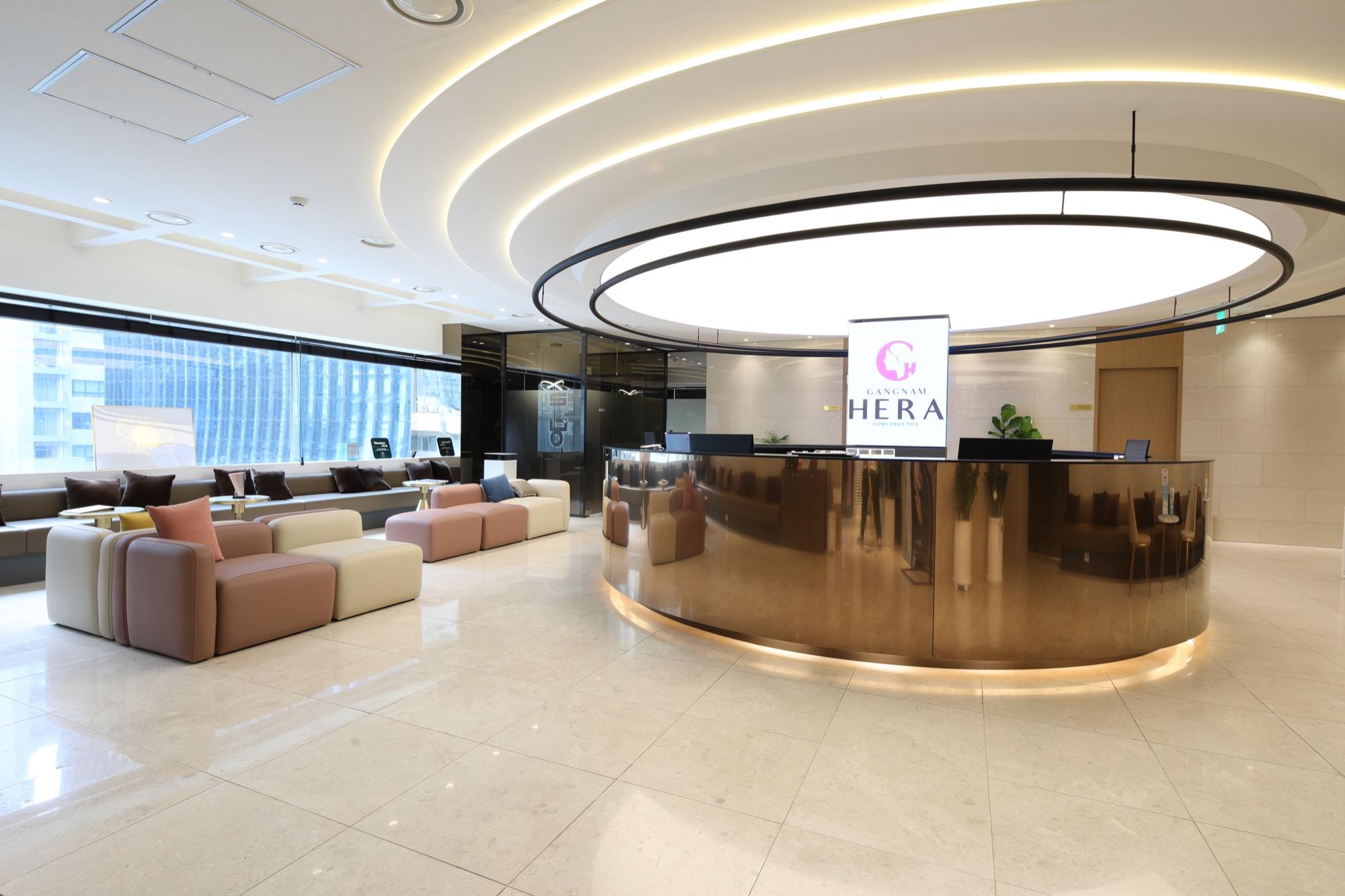 Lifting
Where to Get Thermage in Korea: 6 Checks Before You Book
Choosing where to get Thermage in Korea comes down to a genuine FLX tip, an honest shot count, who holds the handpiece and a published price. Dr. Jin Yi Han walks through six checks to make before you book.
7 minRead →