
Neck Wrinkles Treatment Without Surgery: Two Kinds of Lines
Dr. Jong Hoon Lee of Gangnam HERA explains why horizontal and vertical neck lines are different problems, and how he chooses between soft filler, thread lifting and a diluted CaHA skin booster — with honest limits.
 Dr. Jong Hoon Lee · Gangnam HERA7 min read
Turn on CC for English subtitles.Watch on YouTube ↗
On this page
I'm Dr. Jong Hoon Lee, a director at Gangnam HERA in Seoul. I'm a foundation member of the Korean Academy of Facelift & Contouring, a board member of the International Petit Medical Society, and a co-author of LIFTINGOLOGY: Science and Clinical Practice in Aesthetic Medicine. As soon as the cold wind starts — turtleneck and scarf season — the questions about neck lines come in. So in this video I explained how we treat neck wrinkles without surgery.
My short answer: first work out whether the lines are horizontal or vertical, because they are different problems. Horizontal lines respond well to soft filler placed precisely; crepey vertical lines respond well to a diluted CaHA skin booster; stretched muscle bands may need threads, or ultimately surgery.
Why are horizontal and vertical neck lines different?
Because they have different causes. Horizontal lines are mostly something you are born with; vertical lines come with aging.
- Horizontal neck lines — the creases that run around the neck — are, in most cases, congenital. Even young patients have them.
- Vertical neck lines come with age, and there are two kinds. One is the fine, crepey lines that form as the skin loses elasticity. The other comes from the platysma, a thin sheet of muscle in the neck: as it loosens, it forms visible bands that run up and down.
Which of these you have decides the treatment. That is why I always look at the neck at rest and while you make an expression before suggesting anything.
 01
Soft filler for horizontal lines
 02
CaHA as a skin booster
 03
Cannula technique and combinations
How do you treat horizontal neck lines without surgery?
At HERA we treat them with a soft filler placed exactly in the crease. Other approaches exist — some clinics use wrinkle-relaxing injections, others collagen boosters such as Juvelook — but in my experience, when a soft filler is placed accurately, horizontal lines improve better than people expect.
The important word is soft. There is a ratio at which the filler fills the line easily without feeling lumpy under the skin, and getting that right is the know-how. We treat many horizontal neck lines this way. You can read more about the treatment on our neck line filler page, and about what filler can and cannot do on the neck in neck filler: what it can smooth and what it cannot lift.
What are the options for vertical neck lines?
It depends on how strong the platysma bands are and how the lines behave when you move. In order:
- Very strong bands: surgery is the final option and the one that lasts longest from a single procedure. It is a surgical decision and a different conversation from this article.
- Bands that have stretched noticeably, but you don't want surgery: threads can lift them. Who a neck thread lift suits, and what it cannot do covers this in detail.
- Bands that are not severe, but fine vertical lines crinkle up every time you make an expression: this is where a CaHA skin booster is a strong option.
Not sure which neck lines you have?
Send me two photos of your neck: one relaxed, and one while you tense your neck as if grimacing. That's usually enough for me to tell you whether filler, a booster or threads makes sense.
Real results
Before and after photos of the treatments discussed above.
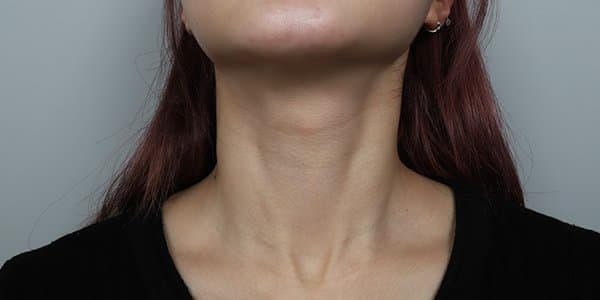
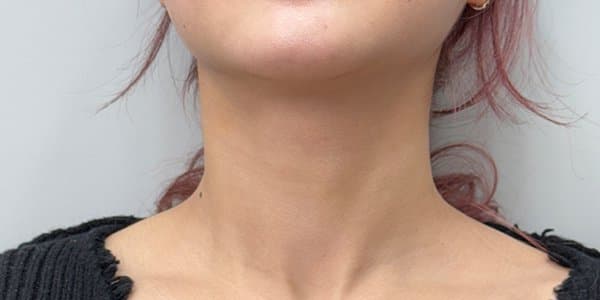
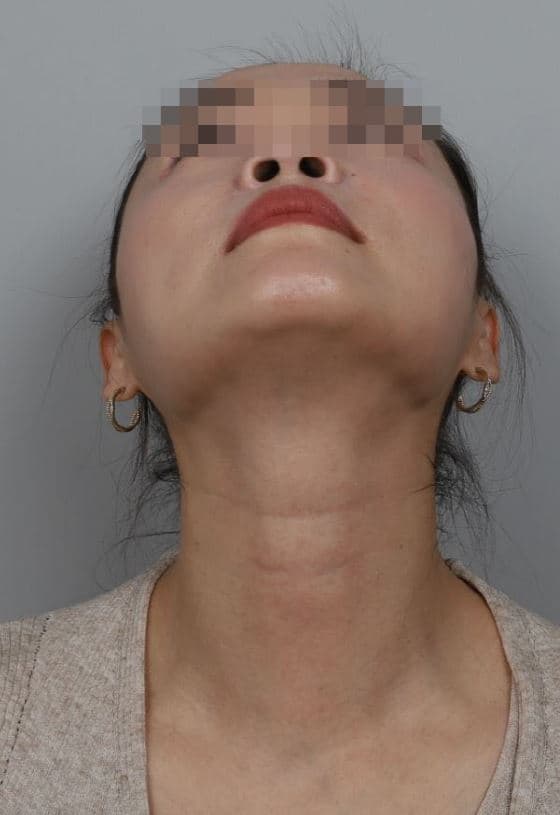
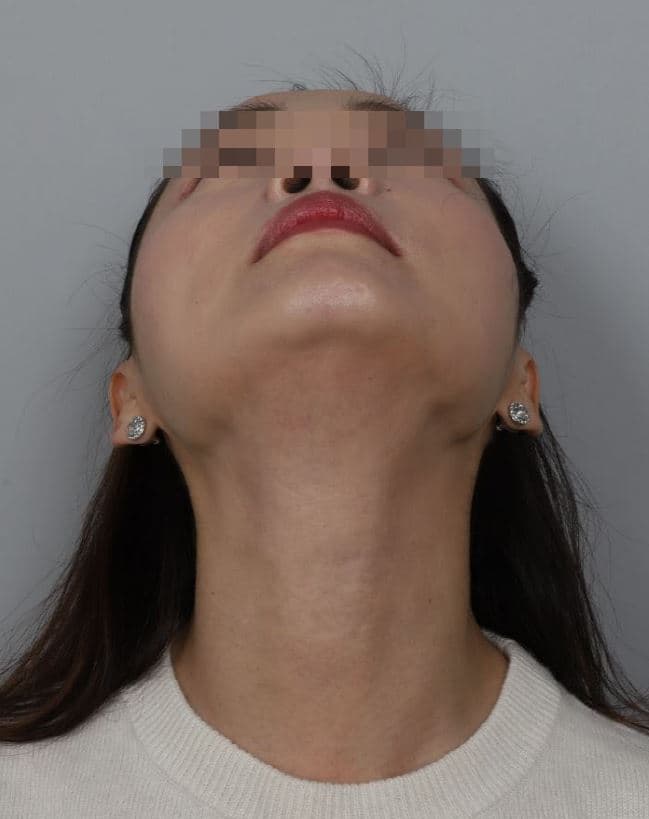
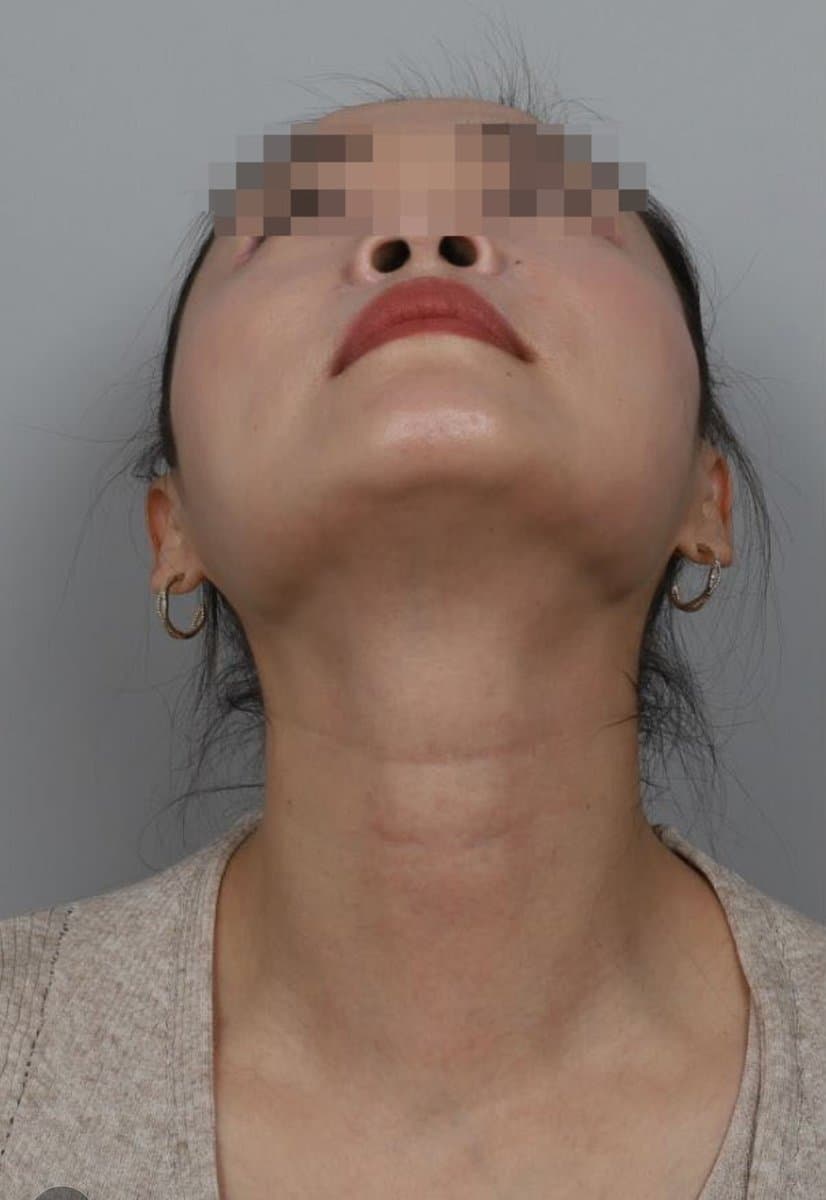
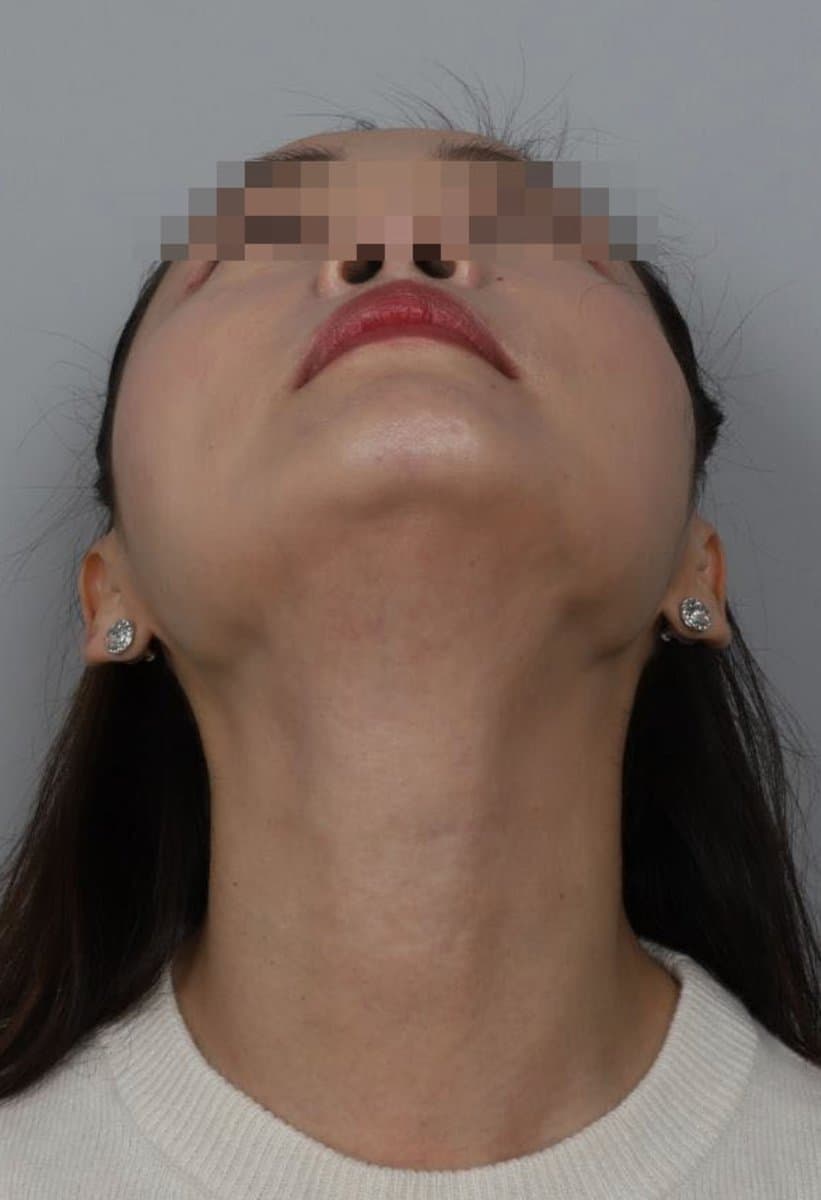
Real HERA patients, shared with consent. Individual results vary.
What is CaHA, and why use it as a skin booster?
CaHA stands for calcium hydroxylapatite. It was first used as a volumizing "calcium filler"; now we dilute it and use it as a skin booster. At HERA, this is our DCLASSY CaHA Filler treatment.
Fine lines appear in many places as we age — around the mouth, on the lips, on the neck, on the backs of the hands. The thickness and elasticity of the skin are completely different in each of those areas, so how we mix CaHA, what we mix it with, and at what ratio — 1:2, 1:3, or a three-part 1:1:1 mix — all change with the area. That flexibility is what makes it useful for the neck.
How does CaHA build collagen?
Mainly by stimulating the cells that make collagen directly, rather than through inflammation. Some collagen stimulators work largely by triggering a controlled inflammatory response. CaHA's collagen response from inflammation is very small — not zero, but small. Instead, the calcium itself stimulates the fibroblasts, the cells that produce collagen.
Compared with a PLLA-type booster such as Juvelook, the difference is that CaHA stimulates not only collagen but also elastin and the extracellular matrix (ECM), the material that fills the space between cells. That helps fill in fine lines more completely. The effect is not a sudden surge of collagen; it encourages collagen production slowly and over the long term.
Why you see something right away
You can see an effect straight after injection. That is because the product is roughly 30% calcium hydroxylapatite and roughly 60–70% carrier gel, called CMC, which has some viscoelasticity. The early effect comes from the gel; as the gel fades, the calcium particles take over by building the skin's own structure.
At a glance

Neck Line Filler
Treatment time · Within about 30 minutes
Recovery · Minimal — you can resume daily life immediately. Mild swelling, redness or small bruises along the injection lines may appear and usually settle within 2–3 days.

DCLASSY CaHA Filler
Treatment time · About 30 minutes
Recovery · Usually short. Most people return to daily activities the same day. Mild redness or slight swelling at the injection points may occur and usually settles quickly.

MINT Thread Lift
Treatment time · 20–30 minutes
Recovery · Usually short. Mild swelling, tightness or small bruises near the insertion points may appear and usually ease within a few days. Avoid strenuous facial movement for a short period.
How is CaHA placed in the neck?
With a blunt-tipped cannula through four or five tiny entry points, spread evenly under the skin. The neck has many small vessels, so bruising is a real possibility. A cannula with a rounded tip reduces that risk. Through four or five small entry points, I fan the CaHA across the inner layer of the skin, which builds a firmer, more even surface.
CaHA is usually the main treatment, but energy-based devices that work on the shallower layers — Thermage or Potenza, for example — can make it more effective when combined. Most patients, though, need only one of these. Re2O, a newer collagen booster I have talked about for fine lines, scars and pores on the face, can also give a similar synergy on the neck when used well.
How many sessions, and how long does it last?
For CaHA on the neck we usually suggest a second session about two months after the first, and two sessions are often enough for a satisfying result. Dose and dilution matter enormously. Juvelook is also diluted heavily and now comes in more types than before; with Juvelook we usually suggest about three sessions, one every four to six weeks. With CaHA the interval is longer and the result tends to last longer. If you are comparing the two, our Juvelook PLLA guide explains that side.
In the end, the result depends on who treats you, the dilution, the ratio and how the products are mixed.
The honest limits
These treatments can give a very good result, but unfortunately none of them is permanent. Habits matter as much as treatment: looking down for long periods keeps folding the neck in the same place. If you take care of your neck and have treatment at sensible intervals, you can keep a firm, younger-looking neck — but maintenance is part of the plan. Bruising, swelling and small lumps can occur after any neck injection and usually settle within days; how your skin responds is individual and your plan is confirmed in consultation. And if your platysma bands are very strong, I will tell you honestly that non-surgical treatment has limits.
You can see real HERA results in our before-and-after gallery.
Treatments discussed in this video
- Neck Line FillerSoft HA filler placed along horizontal neck creases — our first choice for the lines you are born with.
- DCLASSY CaHA FillerThe calcium hydroxylapatite filler HERA offers, diluted for crepey vertical lines and overall neck firmness.
- MINT Thread LiftWhen platysma bands have stretched noticeably but you would rather not have surgery.
- Re2OA collagen skin booster that can add to the result on crepey neck skin, alongside or instead of CaHA.
Read next
FAQ
Frequently asked questions
Q1What is the best neck wrinkles treatment without surgery?
It depends on the type of line. Horizontal creases usually respond best to soft filler placed precisely. Crepey vertical lines respond well to a diluted CaHA skin booster. Stretched platysma bands may need threads, and very strong bands may ultimately need surgery. A doctor needs to see your neck to tell which you have.Q2Can neck lines be removed completely?
They can be softened clearly, but treatment is not permanent and very deep, long-standing lines may not disappear entirely. Maintenance sessions and good posture habits help the result last.Q3How many CaHA sessions does the neck need?
We usually suggest a second session about two months after the first. Many patients are satisfied with two sessions, and the result tends to last longer than with some other collagen boosters. Your plan is confirmed in consultation.Q4Why does CaHA show a result straight away if it builds collagen slowly?
The product is roughly 30% calcium hydroxylapatite and roughly 60–70% carrier gel (CMC). The early effect comes from the gel; as it fades, the calcium particles take over by stimulating collagen gradually.Q5Will I bruise after neck treatment?
Bruising is possible because the neck has many small vessels. For CaHA we use a blunt-tipped cannula through four or five small entry points to reduce that risk. Any bruising usually settles within a few days.
This article explains general treatment principles and is not a diagnosis. Results and suitability vary from person to person; your doctor will decide after an in-person consultation.
Written by
The doctor behind this video
Gangnam HERA
Doctor
Dr. Jong Hoon Lee
Dr. Lee starts by finding where the change in your face actually comes from, the skin, the fat pads or the structure underneath, and builds the plan from there.
 Co-authorLIFTINGOLOGYScience and Clinical Practice in Aesthetic Medicine
How this doctor works
- Finds where the change comes from before planning anything.
- Combines treatments in one plan when one alone won't do the job.
- 25+ years in practice. Clinical instructor at the 2023 KAFC cadaver workshop and recipient of the Minister of Health and Welfare Award.
Education & memberships
- College of Medicine, Chungnam National University
- Recipient, Minister of Health and Welfare Award for Outstanding Contribution to National Health Improvement
- Clinical Instructor, 2023 KAFC Cadaver Workshop
- Board Member, Korean Society for Aesthetic Surgery
- Co-author, LIFTINGOLOGY: Science and Clinical Practice in Aesthetic Medicine
Creator visits
Real visits, reviewed by the doctor
 @yujin.in.seoul10THERA (HIFU) Non-Surgical Face Lift — Custom Face Mapping
10THERA With Custom Face Mapping: A Natural First Lift — Real Patient Review
Dr. Jong Hoon Lee explains Yujin's first non-surgical face lift — how custom mapping to her bone structure shaped her 10THERA session, and what to expect 14 days later.
#10THERA#NonSurgicalFacelift#FaceMappingRead @annatenx10THERA (HIFU) Lifting — Facial Contour Tightening
10THERA Facial Contour Without Filler — A Real Patient Review
Dr. Jong Hoon Lee walks through Anna's 10THERA case — how we chose the zones worth tightening to define her facial contour, without filler and without changing her features.
#10THERA#HIFULifting#FacialContourRead @bydebbietan10THERA (HIFU) Lifting — Lower Face & Double Chin, 800 Lines
10THERA HIFU for a Double Chin, With a Nerve Block — Real Patient Review
Dr. Jong Hoon Lee explains Debbie's 800-line 10THERA session for her lower face and double chin — when HIFU suits a double chin, and why she chose a nerve block first.
#10THERA#DoubleChin#HIFULiftingRead
HERA Journal
More from the blog
 Skin boosters
How Long Does Rejuran Take? Chair Time, Bumps and Trip Days
A Rejuran visit usually takes half a day at most, and the small injection bumps typically flatten within one to three days. The full course takes longer: sessions are spaced two to four weeks apart.
8 minRead → Skin boosters
When Does Rejuran Start to Show? Bumps, Weeks and Your Flight
Rejuran's injection bumps usually settle in a day or two and hydration often shows within weeks, while texture changes build over a course. Dr. Jong Seon Kim on which day of your Seoul stay to book it.
8 minRead → Skin boosters
How Long Does Rejuran Last? Months, Sessions and Trip Days
After a course of about three sessions spaced weeks apart, Rejuran's effect commonly holds for six months to a year. The bumps settle in one to three days, so session spacing shapes your trip more than downtime.
8 minRead →
HERA TV
More long-form videos
 8:07
APTOS Thread Lift Review: A Real Case for Jowls and Double Chin in Her 60s
 Dr. Jong Hoon Lee
 5:29
Korean Pore Minimizer: Home Microneedling vs Clinic Potenza
Dr. Jong Hoon Lee 5:44
Thread Lift in Korea: What Hyaluronic-Acid APTOS Threads Change
Dr. Jong Hoon Lee 4:05
Brow Bone Filler: Adding Depth to a Flat Eye Area
Dr. Jong Hoon Lee 6:06
Eye Ultherapy From the Patient's Chair: Dr. Jong Hoon Lee's Own Session
Dr. Jong Hoon Lee 6:05
Wrinkles Around the Mouth: A CaHA, Ultherapy and RF Combination
Dr. Jong Hoon Lee
YouTube Shorts
One-minute answers from our doctors
Our doctors answering common questions. Tap to play.
Questions after watching?
Send a front and side photo on WhatsApp — the doctor will tell you honestly what they would recommend, and what you don't need.
Ask the doctor on WhatsApp