Best Korean Filler for Nasolabial Folds? A Plastic Surgeon's Answer
 Dr. Jong Seon Kim · Director, Gangnam HERA7 min read
On this page
I'm Dr. Jong Seon Kim, a plastic surgeon at Gangnam HERA in Seoul and a board member of the International Petit Medical Society. The folds that run from the sides of the nose to the corners of the mouth are one of the first places people notice age, and patients often arrive with a product name already in mind. The question is usually: "What is the best Korean filler for nasolabial folds?" My answer first: there is no single product that is best for every fold. What decides your result is why your fold has deepened — and whether filler is the right tool at all. Once that is clear, choosing between a domestic and an imported hyaluronic-acid filler becomes a practical decision about how long you want it to last.
Is there a "best" Korean filler for nasolabial folds?
No single filler is best for everyone; the right choice depends on the cause of the fold, the thickness of your skin and how long you want the result to last. At HERA we use hyaluronic-acid fillers, both domestic Korean products and imported ones. Both are placed the same way, both can be dissolved if an adjustment is ever needed, and both give a visible change straight after treatment.
What patients often expect is that one brand will make the fold vanish. In my experience the product is rarely what separates a natural result from an unnatural one. Placement is. A well-chosen filler in the wrong spot deepens the problem you came to fix; a modest amount in the right spot can soften the fold far more than a large amount placed directly in the crease.
Why do nasolabial folds deepen?
Usually because of what happens above the fold — volume loss in the cheek and mid-face, loosening tissue, and thinner skin — rather than a problem in the crease itself. Everyone has a nasolabial fold; it is part of how the face moves when you smile. With time, the mid-face loses some of its support and the tissue sits a little lower. The fold then looks deeper at rest, and the face can look tired or stern even when you are relaxed.
This matters for treatment. If the main cause is lost volume, filler can replace it. If the main cause is sagging, adding volume alone tends to look heavy, and lifting does more of the work. Most faces I see have some of each, which is why I examine the cheek, the fold and the skin together before suggesting anything.
When is filler the right tool for nasolabial folds?
Filler works best when the fold is visible at rest and comes mainly from lost volume, not heavy sagging. It tends to suit people who have:
- A fold that stays visible when the face is relaxed, not only when smiling
- Some flattening of the central cheek above the fold
- Skin that still has reasonable firmness
- A wish for a natural, softer expression rather than a changed face
It is less suitable when the lower face is clearly sagging, or when the fold only appears during a smile — that movement is normal and filling it tends to look stiff. In those cases I will talk you through other options, below.
Domestic or imported filler — what actually differs?
The main practical difference is duration: at HERA, domestic fillers typically last 6 to 12 months and imported fillers 12 to 18 months, depending on the area and your metabolism. Both are hyaluronic acid, a substance naturally present in the skin, and both can be dissolved.
| Domestic (Korean) HA filler | Imported HA filler | |
|---|---|---|
| Typical duration | 6–12 months | 12–18 months |
| Material | Hyaluronic acid | Hyaluronic acid |
| Can it be dissolved? | Yes | Yes |
| Visible change | Immediately after treatment | Immediately after treatment |
I help patients choose based on how often they can return to Seoul, how their skin behaves and whether this is a first treatment. For a first time, some people prefer a shorter-lasting product while they get used to the change. For a fuller comparison of product origins, see Korean filler vs Juvederm. Results vary from person to person. That is true whichever product is used.
How is nasolabial fold filler done safely at HERA?
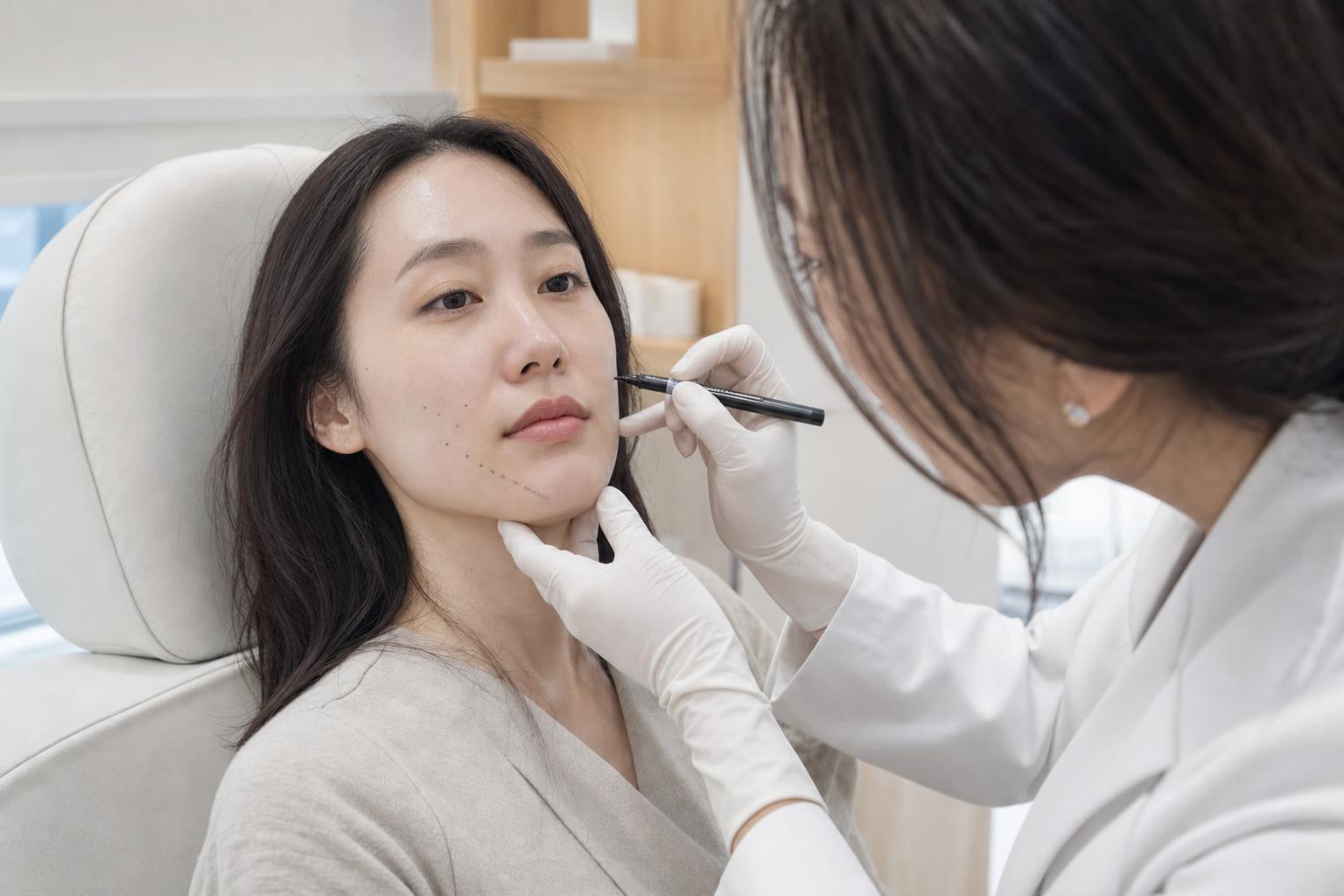
A doctor analyses your face first, maps the injection points, and places the filler at the depth each zone needs — often supporting the cheek as well as softening the fold. The steps are:
- Consultation and facial analysis — volume loss, proportions and your goal
- Design and marking — points are mapped for balanced, natural contours
- Anaesthesia — topical ointment or local anaesthesia
- Injection — hyaluronic-acid filler placed at the optimal depth
- Shaping and symmetry check — the doctor molds the filler and reviews balance with you
- Aftercare guidance — you return to your day straight away
Treatment takes around 10 to 15 minutes. Mild swelling, redness or a small bruise usually settles within two to three days. The area beside the nose has important blood vessels, so pain that keeps worsening or skin turning pale, dusky or mottled needs a doctor the same day; it is uncommon, and it is why a physician injects. Overfilling the cheek to chase the fold is its own problem — our guide to bad cheek fillers explains how that happens and how we avoid it.
What if filler alone is not enough?
When sagging is the bigger part of the problem, lifting or a collagen-stimulating treatment often softens the fold more naturally than extra filler. At HERA the options I consider include:
- Thread lifting — lifting the mid-face softens deep smile lines; our Silhouette Soft Thread Lift page lists the nasolabial folds among its areas, and the thread lift guide explains how threads work
- Collagen-stimulating boosters — DCLASSY CaHA Filler is used for deepened smile folds, combining immediate support with new collagen that builds over the following months
- A combination — a small amount of filler with a lift, planned as one design
To see what lifting changes in the cheek and fold, the cheek thread lift before-and-after guide is a useful companion, and our before-and-after gallery includes nasolabial fold cases from HERA patients.
What patients ask me next
"Will filler make my face look puffy?"
Not if the amount follows your face. Puffiness almost always comes from too much product or product placed in the crease rather than the support around it. I plan a measured first session and review.
"How much does nasolabial fold filler cost?"
It depends on the amount, the product and whether other areas are part of the plan, so you receive an itemised written estimate after consultation. The Korean filler price guide explains what moves the cost, and many patients combine this area with the under-eyes or nose — see the under eye filler price and nose filler price guides.
"Can it be reversed?"
Yes. Hyaluronic-acid filler can be dissolved if an adjustment is ever needed.
The honest limits
Filler softens a nasolabial fold; it does not erase it, and it should not. A face without any fold looks unnatural when it moves. Filler is also not permanent and cannot correct significant sagging on its own. What I can offer is an assessment of why your fold has deepened, the right tool for that cause, and a conservative plan with a review. The clinical detail is on our facial filler page, and the first-timer's guide to fillers in Korea explains how a visit runs.
Book a consultation
If you would like me to assess your nasolabial folds, send a photograph from the front and at an angle, with your face relaxed. We will arrange a consultation in Gangnam, or a photo consultation first if you are still abroad. An English interpreter joins every visit, and you receive an itemised written estimate before anything begins — international and local patients pay exactly the same.
FAQ
Frequently asked questions
Q1What is the best Korean filler for nasolabial folds?
There is no single best product for every fold; the right choice depends on why the fold deepened, your skin and how long you want the result to last. HERA uses both domestic and imported hyaluronic-acid fillers, and placement matters more than the brand.Q2How long does nasolabial fold filler last?
At HERA, domestic fillers typically last 6–12 months and imported fillers 12–18 months, depending on the area and metabolism. Results vary from person to person.Q3Is filler or a thread lift better for nasolabial folds?
Filler suits folds caused mainly by volume loss; lifting suits folds caused mainly by sagging. Many faces have some of both, so the plan can combine a small amount of filler with a lift.Q4Is there downtime after nasolabial fold filler?
Minimal. Treatment takes about 10–15 minutes, most people return to daily life straight away, and mild swelling, redness or bruising usually settles within 2–3 days.Q5Can nasolabial fold filler be reversed?
Yes. Hyaluronic-acid filler can be dissolved if an adjustment is ever needed.
真實經驗
患者怎麼說
由海外患者上傳的影片。




YouTube 上
出發前,先聽聽醫師怎麼說
我們的醫師在鏡頭前講解HERA的主力療程:拉提、玻尿酸與皮膚增強針,讓您在抵達首爾前,就知道會見到誰、他們怎麼思考。
韓語發音 · YouTube 提供自動翻譯字幕
- 6:24玻尿酸

 Dr. Jong · Dr. Jong
- 7:36診所與醫師Dr. Jong · Dr. Jong
- 8:07拉提Dr. Jong
- 5:44拉提Dr. Jong · Dr. Jong
Shorts
一個問題,不到一分鐘
HERA TV
The doctors explain it on camera — then in writing
Each piece is written by the doctor from their own YouTube video: the patient question, why it happens and how we approach it.
 6:56unlicensed filler injections
Unlicensed Filler Injections: The Real Risks, From Two Doctors
Dr. Jong Seon Kim7 min read 6:05wrinkles around mouth treatment
Wrinkles Around the Mouth: A CaHA, Ultherapy and RF Combination
Dr. Jong Hoon Lee7 min read 5:40elf ear filler
Elf Ear Filler: Shaping Flat Ears for a Smaller-Looking Face
Dr. Jong Seon Kim6 min read
HERA Journal
Keep reading
 Fillers
Non-Surgical Nose Lift: Three Clear Days Before You Fly
Nose filler swelling usually eases within two to three days and looks settled by about a week; threads take closer to a week. Treat at least three clear days before your flight, early in the trip.
9 minRead → Fillers
How Long Dermal Filler Lasts: Lips Go First, Under-Eyes Last
Hyaluronic acid filler usually lasts six months to a year. Lips sit at the short end, the nose bridge and under-eyes at the long end, and most swelling settles within a week of treatment.
8 minRead → Fillers
Which Dermal Filler Lasts the Longest? Longer Isn't Safer
Non-absorbable PMMA lasts the longest, then poly-L-lactic acid, then hyaluronic acid. For lips, nose and under-eyes I still choose hyaluronic acid, because it is the one common type that can be dissolved.
9 minRead →